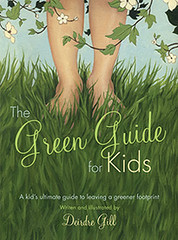
This website is an online environmental resource for kids to find ideas, information, and inspiration to go green.

Invite...

Invite Deirdre to visit your classroom or organization to teach kids more green tips and projects.

Share your ideas...

Do you have a story, idea or artwork that you would like to share? Send me an email!

Join My Mailing List!


Well said...

“We still talk in terms of conquest. We still haven’t become mature enough to think of ourselves as only a tiny part of a vast and incredible universe. Man’s attitude toward nature is today critically important simply because we have now acquired a fateful power to alter and destroy nature.” - Rachel Carson


Redwoods by Jason Chin

“Stunning... inventive... eye-opening...”
-Kirkus Reviews

REDWOODS
by Jason Chin

RedwoodsBook.com

email me for advertising rates

Tuesday, July 7, 2009

John Muir - A Green Pioneer


“Everybody needs beauty as well as bread, places to play in and pray in, where nature may heal and give strength to body and soul.” –John Muir


John Muir (1838-1914), known as “the father of our national parks”, was America’s most famed naturalist and conservationist. As an explorer, he embarked on exciting wilderness adventures from Indiana all the way to Florida, among Alaska’s glaciers and throughout California’s Sierra Nevada. During his journeys he kept nature journals in which he wrote about the beauty he saw in nature. He drew detailed sketches of plants, animals, mountains and landscapes. He used these journals to compose letters, essays, articles and books that taught people, then and now, the importance of experiencing and protecting nature. His writing and activism inspired President Theodore Roosevelt’s bold conservation programs and lead to the creation of Yosemite, Sequoia, Mount Rainier, Petrified Forest and the Grand Canyon National Parks. In 1892, John Muir formed the Sierra Club and was the club’s very first president. The Sierra Club continues John Muir’s work today, teaching people about conserving our natural heritage and establishing new National Parks and a National Wilderness Preservation System.


Wednesday, June 10, 2009

Summer's almost here!


For many families, piling suitcases, kids and even cats and dogs into the car for your summer vacation is a yearly tradition. You and your family can green your car trip and get the summer off to a cool start by trying these simple steps:

1) Don’t idle. Have you ever walked behind a car in a parking lot that was sitting with it’s engine going? Cough! Cough! Idling causes unnecessary pollution. It’s a good rule of thumb to turn off your engine when parked for more than 30 seconds. The best way to “warm up” your car is to drive the vehicle and it will be “warmed up” in 30 seconds.

2) Lighten up! Get that junk out of your trunk. Driving around with unnecessary weight makes your car less fuel efficient.

3) Be a smooth operator. Avoid jerky starts and stops and use cruise control to maintain a steady speed. And slow down! Your car uses less fuel when driven close to the speed limit.

4) Keep it in tune. Get regular tune ups and make sure your car’s tires are properly inflated to boost it’s MPG.

5) Check your cap. Many cars have missing or broken gas caps which cause gas to leak and harm the environment.

6) Don’t be a drag. Remove bicycle and ski racks when not in use, and keep those windows closed when driving on the highway to reduce drag and improve your fuel economy.

7) Make a plan, Stan. Plan your route to avoid sitting in heavy traffic.

Wednesday, May 27, 2009

White is the new green

Photo Courtesy of the Pennsylvania State Archives

Have you ever touched a black car that's been parked in the sun? Hot tamale! Dark colors like black absorb heat while light colors like white reflect heat. That's one reason why apartment buildings with black tar roofs heat up like an oven in the summer. That's also why you can cook an egg on pavement on a scorching hot day. As people replace heat reflecting and carbon storing forests, streams, and valleys with heat absorbing and carbon producing cities, roads, and strip malls, the Earth gets warmer and warmer. One way to help counter the problem is to paint flat black rooftops white, which is exactly what President Obama is encouraging us all to do. White roofs are a double benefit. They reflect heat away from the surface of the planet and help keep buildings cool and therefore reduce energy use from air conditioning.

President Obama is even taking this idea to the street. He is encouraging painting cars in light or cool colors to make them more fuel efficient by reducing the need to turn on the air conditioner. Pavement will also be made a cooler color, so we'll have to stick to frying our eggs in a pan.

If your family owns your home, encourage your parents to go white. If you are like many city kids who live in a building with many families, talk to the building owner about going white to go green.

Wednesday, May 13, 2009

I uses to wear WHAT???


I don't know about you, but I feel like throwing a tantrum every spring as I pull out the clothes I wore last summer and try to cram my winter clothes back into boxes to store under the bed. So what's a person to do? Throw those unwanted clothes away? No Way! You can swap them, sell them or donate them. Chances are someone will want to wear your hot pink jean jacket! 

To learn about swapping your clothes, check out these great websites:


Or hold  your own swap meet and trade clothes with your friends!

Here are some websites to sell your clothes (if you are a kid...don't forget to ask mom and dad!)


You can always donate your clothes to those in need:


And for those items of clothing that are beyond salvage, you can recycle them. Some farmers markets collect textiles for recycling.

Happy cleaning!

Sunday, April 26, 2009

Meet Tim Magner, Part 2


We are back with more questions for author Tim Magner, about two more of his books for young readers: N IS FOR NATURE: AN ENVIRONMENTAL ALPHABET BOOK and EARL THE EARTHWORM DIGS FOR HIS LIFE.

Both of these books aim to teach kids about many of the creatures we share our planet with, even the microscopic ones burrowing right under our feet! In your opinion, why is important that kids learn how other creatures live?

Since the beginning of human history, kids played outside. As part of every normal childhood, kids had plenty of time to wander, investigate and discover. Digging in the dirt and imitating animals gives them a chance to bond with the earth around us. Toddlers can identify with animals (especially young ones) and they grow into explorers who come to understand the connections and see us as a part of nature. Sometimes it's important to remember our roots.

EARL THE EARTHWORM DIGS FOR HIS LIFE teaches us about the amazing work of worms and how we can use them to create compost from our organic waste. Is this something that even city kids can do?

Our Earl story is entertaining in and of itself, but it's also about how, in nature, waste equals food. I love visiting schools and bringing some of my worms. Many of the city kids have never felt worms and can't believe I keep 1,000-plus of them in my kitchen. Vermi-composting is a way to explain nutrient flows and cycles. I'm a big proponent of the benefits of systems thinking over linear thinking and using nature as a model to help us move past the short-term thinking of the Industrial Revolution to a better future. 

Your books really encourage kids to get outside and play. What was your favorite game to play outside when you were a kid?

We lived near a golf course and my brothers and I hunted for golf balls in the creeks and ponds. We came home well after sunset, covered in mud. Mom yelled at us. We also got to spend chunks of time in Wisconsin where we played with neighborhood kids, games like kick the can and flashlight tag. Good clean fun means getting dirty.

Tuesday, April 21, 2009

Happy Earth Day!


Join in on the fun and renew your commitment to help protect our planet at an Earth Day event in your community. Visit The Earth Day Network to search for events taking place in your area.

If you'd rather stay close to home, why not pick out a green activity or find a new way to get involved?  (And get your family and friends involved, too!)

Let us know what you are doing for Earth Day!

Sunday, April 19, 2009

Meet Tim Magner, Author of AN ENVIRONMENTAL GUIDE FROM A TO Z


Just in time for Earth Day, we have a special interview with Tim Magner, the author and publisher at Green Sugar Press, whose books encourage kids to explore, examine and investigate the natural world around them. His book AN ENVIRONMENTAL GUIDE FROM A TO Z, provides 26 opportunities for kids to learn about the Earth they live on. From the Amazing Amazon to the Zoo, every letter explores a topic, idea or solution to better help kids comprehend and care for for the environment. Let's ask him a few questions!

What inspired you to write AN ENVIRONMENTAL GUIDE FROM A TO Z?

Patrick, one of my seventeen nephews, and now in 3rd grade, kept telling me about what he was learning in school—from the destruction of the rainforest to the struggling polar bears. He was sad. I chose to write a book about the wonders of the natural world and to encourage kids to get out and learn more about it by enjoying it.

What is you favorite letter in the book and why?

Can I have two? "L is for Lugari" is fun because I spent a couple weeks in Colombia visiting with Paolo Lugari and Gaviotas. Seeing firsthand how Lugari turned a wasteland into a new forest was over-the-top cool. I also love the "C is for Cycle" page, probably because I like conversations about how nature has no garbage dumps. When I visit classrooms I usually bring my worms and explain how they eat my left-overs and turn it into a valuable fertilizer for my plants.

Your book explores many different regions and people in the world. Why should a kid living in a city care about Mt. Kilimanjaro or the Inuit Eskimos?

Funny you should ask. Actually, I believe it's far more important they first know their backyards or nearby park than Africa or the Arctic. Learning about nature starts with the nearby and expands, so we included ideas to get out and learn more about what's around them, i.e. "Have you considered keeping a journal of your local habitat—to write about what you see, smell and hear?" 


What is the single most important idea about the environment that you wish all kids knew?

Again, just one?
I want kids to know that exploring outside is loads of fun and, chances are their parents and grandparents got to have more fun than they did because they got to play outside often.
As John Burroughs said, "Knowledge without love will not stick, but begin with love and knowledge is sure to follow." So, once kids fall in love with the earth, they'll learn that we need nature for everything in life. Better yet, nature teaches us everything we need to know—from energy flows and nutrient cycles— to create a better future. 

This is the most exciting time in the history of the world to be alive.